
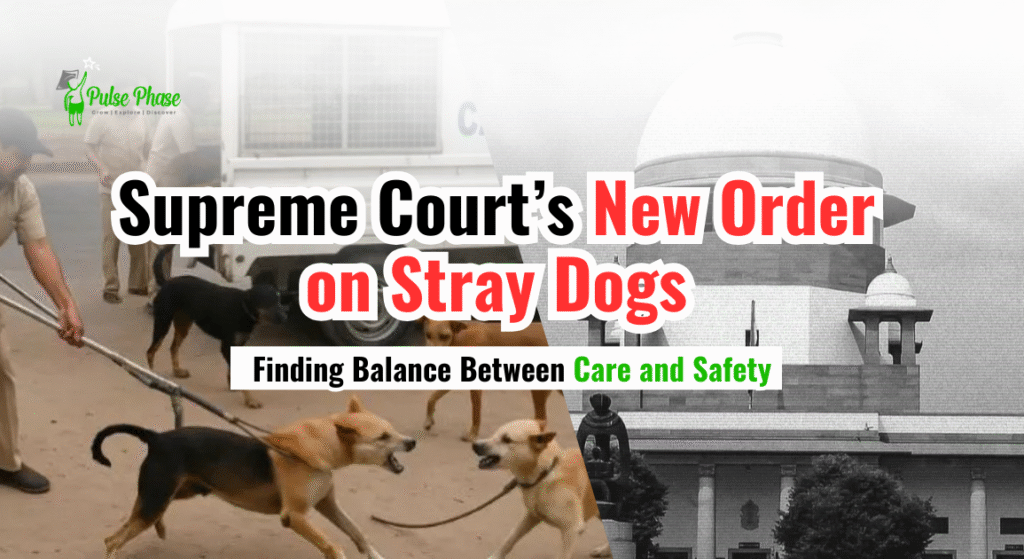
The Supreme Court order on stray dogs signals a pivotal shift in how India addresses the delicate balance between public safety and animal welfare. In a significant update, the Supreme Court judgement on stray dogs 2024 has overturned its earlier directive of August 11 and instead mandated the stray dog sterilization rules, vaccination, and release of stray dogs back into their original neighborhoods, excluding those that are rabid or show aggressive behavior. The Supreme Court’s new order on stray dogs also introduces designated dog feeding zones, emphasizing both compassion and control, like street dog care and safety zones, while reinforcing humane guidelines for managing the country’s urban stray population.
The issue of stray dogs in India has become a point of debate. Some people care for them lovingly, considering them street animals that require food, affection, and care. However, for the rest, these animals are a nightmare – stray dog bite cases in India, exhaustion, and even infections like rabies, washing around heavily, and living. And yesterday, the Supreme Court ruling 2025, once again on Delhi stray dog cases, issued a new order for dogs, in an effort to reconcile two standpoints, issued a relatively controversial order.
This revised Supreme Court’s order on street dogs is a calibrated response to mounting concerns over stray dog-related incidents and rabies outbreaks, which saw Delhi recording 25,000 bite cases in 2024 alone. By upholding the Animal Birth Control (ABC) Rules and mandating careful implementation by municipal authorities, the Supreme Court aims to restore a practical approach to humane stray dog management—one that protects both animal welfare vs public safety.
The verdict of The Honourable Supreme Court of India (2025) is not necessarily about dogs per se, but about how the two ’emotions of feelings and solution thinking ‘can co-exist in a society and in what proportion.
Looking Back: The Earlier Order
The prime objective of the Court was to compassionately put an end to the fights in residential colonies that would worsen sanitation. Everyone would feed stray dogs, but in designated points, as the Court had care to mention. In a previous case, the Court had given the right of citizens to feed stray dogs with an exception that the feeding be only done at one place. However, the vision that looked pragmatic on paper seems to have had a strong disruption in practice. A section of residents also noticed that dog feeding was the reason for there to be an increase in dogs in residential societies and playgrounds. Most parents had problems with their children going to school, while others simply turned down the idea of going for evening walks when they would bump into feral dogs.
Followers of the Animal Welfare Board of India were in the other camp, where they fought for the cause of those who argued in favour of love and not fear for animals. In their view, feeding was never a problem; it was the lack of sterilization, together with any kind of vaccination. According to them, the Prevention of Cruelty to Animals Act was essential, and by analyzing other aspects convincingly, it could be concluded that abusing strays was not only unethical but also unlawful.
So, the country found itself between compassion and fear.
Supreme Court’s new order on stray dogs
The Supreme Court’s modified order on stray dogs tries to bring clarity. Feeding dogs has not been banned. Instead, the Court has placed the responsibility on local bodies—municipal corporations and panchayats—to earmark feeding zones. The logic is simple: feed dogs, yes, but do it responsibly and in a way that doesn’t make life difficult for other residents.
The Court also reminded authorities of their duty to enforce the Animal Birth Control (ABC) Rules, 2023. That means sterilization and vaccination cannot remain half-hearted drives carried out once in a while. They need to be systematic, large-scale, and ongoing. Without this, India’s stray dog numbers—currently estimated at over 60 million—will remain unmanageable.
In other words, the Supreme Court’s new order on stray dogs is not just about where to feed, but also about how to control the population and reduce risks of dog-mediated rabies.
READ MORE ABOUT: Insights, News
Why the Stray Dog Issue is So Urgent
India’s relationship with its street dogs is unique. Unlike many countries where strays are rarely seen, Indian cities, towns, and even villages are home to millions.
This creates serious consequences:
- Dog bite cases run into the lakhs every year.
- Rabies remains a deadly threat, with WHO data suggesting more than 20,000 Indians die from it annually.
- Overcrowded neighborhoods often see conflicts, not just between humans and dogs but also among residents themselves.
- And yet, the dogs themselves live in harsh conditions—often starving, injured, or diseased.
So the problem is double-edged: people’s safety is at risk, and animals are suffering too.
A Clash of Perspectives in Communities
If you’ve ever lived in an Indian housing society, you’ve probably seen this play out. Some residents treat the strays like their own pets, naming them, feeding them daily, and even celebrating their birthdays. Others—sometimes living on the same block—will argue that the dogs bark at night, chase delivery boys, or scare children.
Both sides have a point. Feeding may comfort the animals, but it can also attract more dogs to the same spot. On the flip side, simply driving dogs away doesn’t solve the issue either—they return, hungrier and more aggressive.
This tension explains why the Court’s order insists on a middle path: follow feeding stray dogs rules, but in designated areas; care for them, but also sterilize and vaccinate them ( street dog care and safety balance).
Public Health And Stray Animals: Rabies and the 2030 Target
Rabies is perhaps the most frightening angle here. India has set a target to eliminate dog-mediated rabies by 2030, in line with the global WHO plan. But that cannot happen without aggressive sterilization and vaccination campaigns.
Some cities have shown progress. Jaipur, for example, is often cited as a model because of its consistent trap-neuter-return (TNR) program. However, many local governments have a hard time. Resources are scarce, the skills of employees are poor, and the functioning with animal welfare bodies is lukewarm.
Has everyone taken the Animal Birth Control Rules 2023 seriously, yes? Otherwise, it will be a joke for some day.
So, What Can Actually Work?
Solutions are not difficult to understand. All they need are effective methods of application.
- Expand the promotion of sterilization and vaccination: it is known that this is the sole method to stabilize the cast.
- Trapped, neutered, and released (TNR) – dogs are fixed, immunized, and released to their prefixed area.
- Down pushes – Dangerous dogs should not be roaming the streets, but rather be kept in shelters for safety reasons.
- Mobilization – citizens should be in a position to behave friendly towards stray dogs, know how to make non-provocative actions to provoke a biting attack, and know how to report mauling attacks quickly.
- Owning and taking care of a pet that is stray in nature – The fewer animals left to be stray, the better. It is recommended to get a pet that needs a home and not to purchase a particular type of pet.
- Youth work – students can either volunteer for dog shelters and awareness campaigns or distribute information about puppies to the community around them.
- Community strength – The law has always been there, but until the regions have responsibilities and financial resources, there is no movement.
Effective communication and taking steps have always been the issues.
The Legal Backbone
There should be a clear understanding of the fact that India has advanced laws in theory:
- The Prevention of Cruel Treatment to Animals Act gives protection to strays from harm.
- The ABC Rules, 2023, detail how sterilization and vaccination must be carried out.
- The AWBI functions as a nodal agency for guidelines.
But laws only work when enforced. Without monitoring and budgets, even the best-written rules remain ineffective.
A Personal Take
I’ll admit something: I’ve seen both sides up close. I once watched a street dog wag its tail and follow a group of school kids like a friend, and the kids loved it. A week later, in the same neighborhood, panic spread after a bite case. That’s how quickly the mood changes.
Maybe that’s why this new order feels necessary. It accepts the reality that strays will remain part of Indian streets, at least for the near future. But the prohibiting factor is to maintain them humanely while also ensuring the safety of common areas. (Supreme Court stray dogs order date, Supreme Court order on feeding stray dogs, Supreme Court stray dogs order date)
Conclusion
The stray dog problem in India is not one that vanishes overnight. While the latest Supreme Court’s order on stray dogs reframes the issue as a national stray dog crisis, it also lays out clear guidelines for sterilization, vaccination, and humane management. These measures aim to control the population while ensuring compassionate treatment of stray animals.
But whether this balance succeeds will depend less on what’s written in the judgment and more on how local communities, municipal authorities, and animal welfare groups act on the ground. The effectiveness of stray dog sterilization programs and designated feeding zones will determine if the preventive measures actually reduce conflicts.
The truth is, stray dogs in India aren’t going away overnight. The real question is: do we want a future defined by fear and rising dog bite cases, or one where public safety, animal welfare, and science-based solutions work together? For India, the answer will shape not just the lives of millions of stray dogs, but also the safety, health, and peace of mind of millions of people.
FAQs on the Supreme Court’s new order on stray dogs
1. Has the Supreme Court banned feeding stray dogs?
No, feeding hasn’t been banned. The Court just said it should be done in designated places decided by local bodies, so it doesn’t create fights in residential colonies.
2. Who is responsible for controlling stray dog populations now?
Local authorities like municipalities and panchayats have been made accountable. They need to enforce sterilization and vaccination drives under the Animal Birth Control (ABC) Rules, 2023.
3. Why is sterilization so important in this debate?
Because it’s the only long-term solution. If dogs aren’t sterilized, their numbers will keep growing, which means more bites, more conflicts, and more rabies cases.
4. What should people do if there are too many dogs in their area?
The right step is to report it to the municipal body, not to harm or drive the animals away. Complaints should push local authorities to carry out sterilization, vaccination, or relocation to shelters.
5. How does this order affect ordinary citizens?
For residents, it means safer streets if implemented well. For animal lovers, it means they can still feed and care for dogs—just in a way that’s more organized and responsible.
READ MORE ABOUT: Current Affairs